Two spheres of life in points — as they are, without judgement. And resources: what you have enough of and what is short.
HUMAN ARCHITECTURE
A Future Decoder lab · starts 3 January 2027
The world is bigger
than what
we see.
Not only looking for answers to old questions.
Learning to ask new ones.
We look at life as a system of eight spheres — and start not with ourselves but with the world. Every value has many external ways to be fulfilled, and most of them we simply don't see. We build the system to last, but flexible: with tools to rebuild decisions when the context changes.
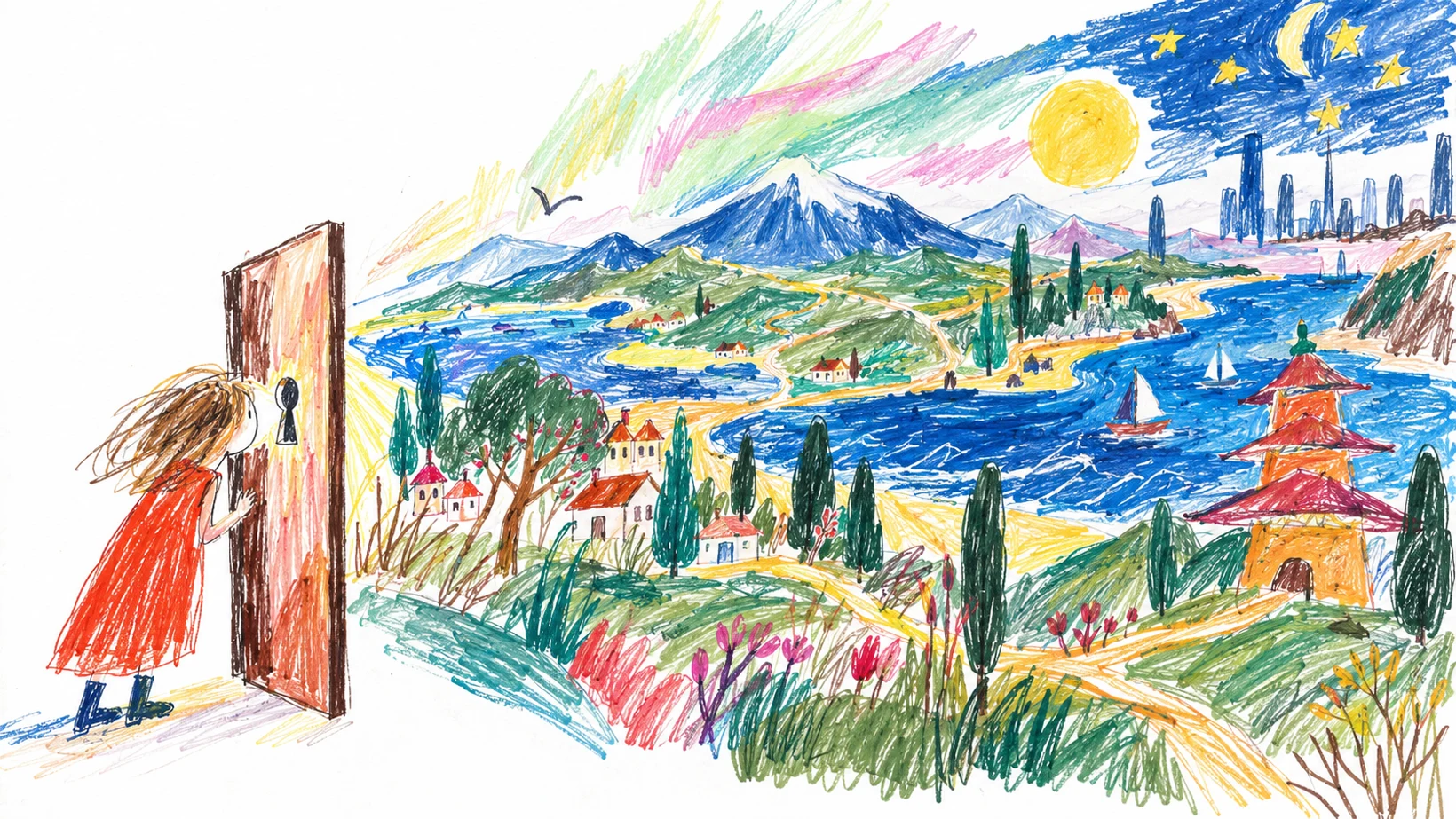
What lies beyond it?What if we ask a different question?
5 online meetings8 spheres of life10 places in the cohort
Decision research · Futures scenarios
Systems analysis
Online lab · free
Try it yourself —
right now.
A short version of the lab runs in your browser. No sign-up: your answers stay on your device only. It takes from forty minutes to a couple of hours — you can stop and come back.
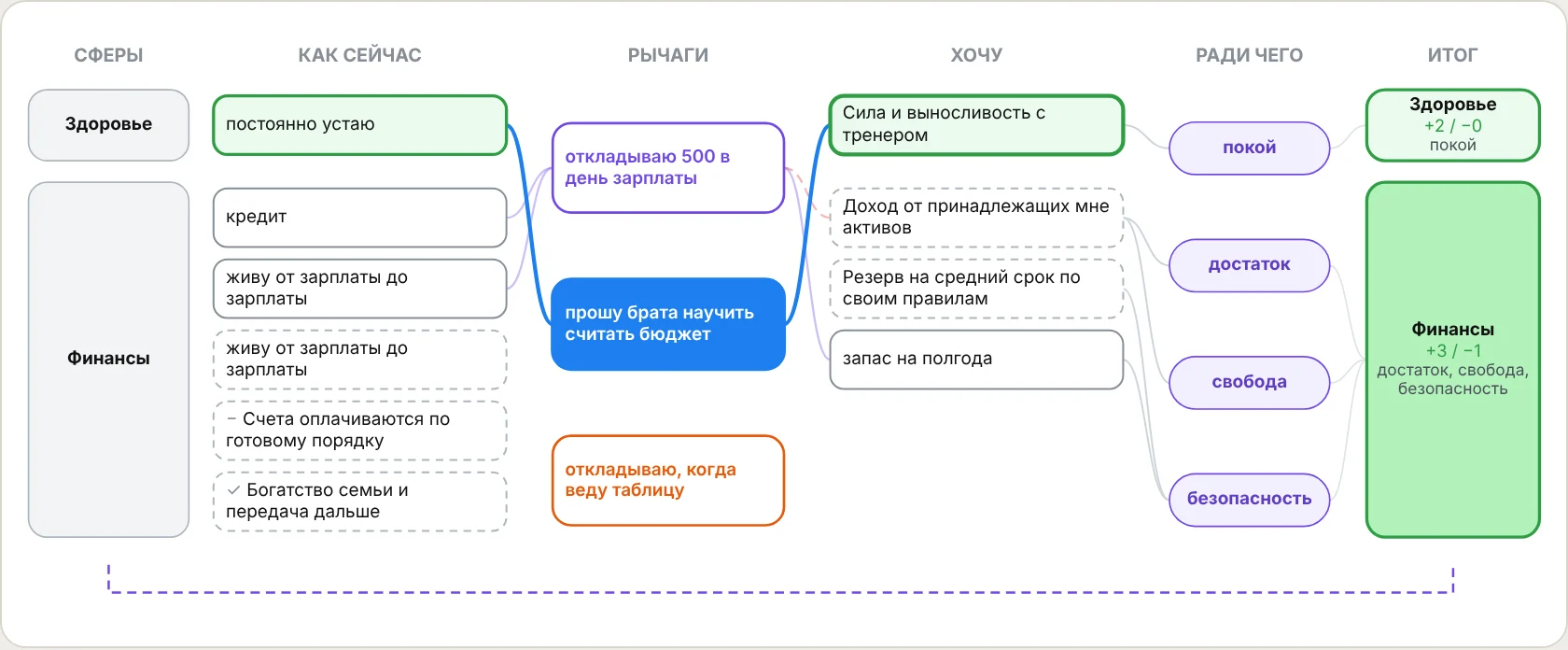
Your own wants and options from the four worlds. For each — what it is for, and whether it is a goal in itself or a way.
You live one day in the life you want and drop the wants that turn out not to be yours.
Beliefs and contradictions that hold you, and four “how else” questions: hand it to others, without it, a small step, through people.
A map: what each lever improves and what it hurts, loops, a year map by quarters.
A first step for the week: “when…, I…”, a calendar reminder and a promise to yourself in PDF.
Open the online lab
The live lab does the same, only deeper: all eight spheres, a group and a review with Olga.
Approach
Life as a system.
Built to last — and flexible.
Most personal strategy programmes start from the inside: your drivers, your calling, your value axes. We start from the outside — from the many ways the world already offers what matters to you.
Values have external ways
Security doesn't come only from money: services, big systems, your own tools and people nearby give it too. First we look at these ways across the four logics of the world and real signals — then you choose yours.
One map instead of a list of goals
Eight spheres, your “now” and “want”, values and levers — on one scheme. You see which step moves several spheres at once, what you pay for it and what isn't supported yet.
Built to last, but not frozen
Not a ten-year plan that breaks at the first change. A system where, when the context changes, the lever changes — not your whole life: testing against different scenarios, review in cycles, the first step as an experiment.
01 / From habitual choice — to inquiry
You are already choosing
the future.
Work, study, moving — every decision holds an idea of what comes next. In the lab we make these assumptions explicit: we look at options and test the grounds for the choice.
1978Prize
in economics*
in economics*
We don't see all the options.
Herbert Simon studied decisions under limited knowledge and limited capacity to process information. We don't compare every path available in the world.
Herbert Simon · NobelPrize.org ↗2002Prize to Daniel Kahneman*
Wording changes the choice.
Kahneman and Tversky showed that different descriptions of the same problem can lead to different decisions. It's not only about the answer but about how the question is put.
Tversky and Kahneman · 1981 study ↗The story of one experiment
Participants were offered options with identical outcomes, described either as lives saved or lives lost. Preferences changed with the wording.
In 2002 Daniel Kahneman received the prize for bringing psychological research into economics, especially the study of decisions under uncertainty. It is not a prize “for designing life”.
Official prize description ↗2007Research on
memory and the future
memory and the future
We build the future from experience.
Schacter, Addis and Buckner described the link between memory and imagining the future. Stored experience becomes material for new possible events.
Schacter, Addis, Buckner · review ↗* The Sveriges Riksbank Prize in Economic Sciences in Memory of Alfred Nobel. These works explain how choice works; they do not confirm the effectiveness of our programme.
A new question — other options.
The usual question
How do I fit everything in?
A different question
What should change in how I work to keep my income and free up time?
Training examples of how we work with questions. Not a replication of Kahneman and Tversky's experiment and not a guarantee of results.
02 / How we make decisions
From information —
to your own option.
Five points where you can notice a habitual choice — and try to act differently.
01
Information
What do I build my picture of the world from?

How it often goes
I see fragments
News, familiar opinions, alarming events. I may take a visible part for the whole picture.
How it could be
I widen the context
I study different spheres, data and people's experience. I weigh threats, opportunities and what I don't know yet.
Research basis / 01
On average, negative news triggers a stronger physiological response.
Soroka, Fournier, Nir · 2019Learn more
What was studied
In 17 countries, people's physiological responses to real TV news were measured.
What was found
On average the response to negative news was stronger. But people differed considerably.
How we apply it
We don't stop at the news feed. We compare sources and look at changes in work, education, technology and everyday life.
The study doesn't prove that bad news inevitably creates a negative future. Widening the context is our practical principle.
Study: original source ↗02
Vision of the future
What future do I imagine?
How it often goes
I extend the familiar
I build one image of the future from past experience. Other options may simply not come to mind.
How it could be
I build scenarios
I imagine several options. I separate what I want, what is possible and what I'm only assuming.
Research basis / 02
Memory and imagining the future rely on partly shared brain systems.
Schacter, Addis, Buckner · 2007Learn more
What was studied
Data on remembering the past and mentally simulating future events were compared.
What was found
Stored information serves as material for constructing a possible future.
How we apply it
We add new examples to personal experience. In groups we compare different ways to work, study, live and interact.
Imagining a scenario is not predicting an event. Rich imagery doesn't guarantee an accurate forecast.
Study: original source ↗03
Path
How do I move from an image to action?
How it often goes
I follow the familiar track
I picture the result and start with familiar actions. I don't always check the conditions, obstacles and the cost of the route.
How it could be
I test the route
I weigh the goal against resources and constraints. I choose a small step and the signs by which I'll judge the result.
Research basis / 03
It helps to contrast the desired future with obstacles, not just picture it.
Gabriele Oettingen · 2012Learn more
What was studied
How different ways of thinking about a desired future relate to effort and goal attainment.
What was found
Contrasting the future with reality helps match effort to how achievable a goal is — including letting go of unrealistic goals.
How we apply it
We describe the desired transition, constraints and available resources. Then we choose an action that can be tested.
This is not a guarantee of reaching the goal. Sometimes the well-founded result is to change the goal or drop the chosen route.
Study: original source ↗04Cognitive
Cognitive
blinkers
What do I stop noticing?
How it often goes
I defend my picture
I look for confirmation of the path I've already chosen. I may skip contradicting information or explain it in my favour.
How it could be
I leave room for the new
I ask: what could disprove my idea? What changes would require rethinking the route?
Research basis / 04
We tend to seek and interpret information in favour of existing beliefs.
Raymond Nickerson · 1998Learn more
What was studied
Data on how people seek and interpret information when they already hold a belief or hypothesis.
What was found
Confirmation bias shows up across tasks and can sustain a one-sided assessment of information.
How we apply it
We formulate alternative explanations and decide in advance which results would make us change the decision.
“Cognitive blinkers” is our metaphor. It isn't a scientific term and doesn't mean the brain literally blocks information to reach a goal.
Study: original source ↗05
Creativity
What new can I put together along the way?
How it often goes
I repeat what's ready-made
I choose from familiar solutions or copy the visible part of someone else's success. New combinations stay out of the frame.
How it could be
I create my own option
I connect ideas from different spheres. I invent, try and change the solution — not only before the start but along the way.
Research basis / 05
Memories, images of the future and new ideas engage partly shared brain areas.
Roger Beaty and colleagues · 2018Learn more
What was studied
Brain activity was compared while participants remembered the past, imagined the future and came up with unusual uses for objects.
What was found
Overlapping activity was found in areas linked to memory, imagining the future and creative thinking.
How we apply it
We work with combinations: one need — different ways to meet it. We don't look for a single “right” way of life.
Overlapping brain activity doesn't prove that the programme boosts creativity. Creativity is possible at any stage, not only the last one.
Study: original source ↗The five stages are Future Decoder's own scheme, not an established sequence of how the brain works. In life these processes overlap: we refine information, change the route and invent new things at any step.
03 / Scientific foundations
What the lab
is based on.
Not a set of famous names. Each source has a specific role. We show research findings, working tools and our own decisions separately.
01 / Research
Describes how we notice information, imagine the future and make decisions.
02 / Tools
Scenarios, working with assumptions and systems analysis help break down the task.
03 / Our own method
Four worlds, eight spheres and five meetings are Future Decoder's structure, not a scientific classification.
All sources / 13
Soroka, Fournier, Nir
Cross-national evidence of a negativity bias in psychophysiological reactions to news
PNAS · experimental study
Schacter, Addis, Buckner
Remembering the past to imagine the future: the prospective brain
Nature Reviews Neuroscience · review
Gabriele Oettingen
Future thought and behaviour change
European Review of Social Psychology · review
Raymond Nickerson
Confirmation Bias: A Ubiquitous Phenomenon in Many Guises
Review of General Psychology · review
Roger Beaty and colleagues
Core Network Contributions to Remembering the Past, Imagining the Future, and Thinking Creatively
Journal of Cognitive Neuroscience · fMRI
Herbert Simon
Decision making in economic organisations
NobelPrize.org · description of the laureate's contribution
Amos Tversky and Daniel Kahneman
The framing of decisions and the psychology of choice
Science · experiments with problem framing
Daniel Kahneman
Judgement and decision making under uncertainty
NobelPrize.org · description of the laureate's contribution
Donella Meadows
Leverage Points: Places to Intervene in a System
A methodological essay on systems thinking
Susan Michie, Maartje van Stralen, Robert West
The behaviour change wheel: a new method for characterising and designing behaviour change interventions
Implementation Science · the COM-B model: capability, opportunity, motivation
Peter Gollwitzer
Implementation intentions: strong effects of simple plans
American Psychologist · “when…, I…” plans
Stuart Candy, Jake Dunagan · John Willshire
Experiential Futures Ladder: the future as a situation and a thing
A methodological approach, not a study of this programme
04 / A Future Decoder tool
One need.
Different ways.
We look at life through four models of how the world is organised. We don't choose the “right world” — we look for a combination of solutions that fits your conditions.
When it feels “unrealistic, no money, no time”, we ask four questions: what can you hand to others, how can you do without it, what small step already gives a little, who can help. Each answer is already an option for action.
Apply to the eight spheres of life ↗An educational institution
A common curriculum, teachers, a timetable and an in-person community.
An educational platform
A single digital system, a large catalogue and automated support.
A circle of practitioners
Learn from people, exchange experience, do a joint project.
Your own trajectory
Assemble learning from open materials, digital tools and connections.
Centre / decentre — how decisions are organised and distributed. Earth / synthetic — emphasis on living environments or technological systems. These are our own models, not an exhaustive list of ways to live.
05 / From inquiry — to action
Five meetings.
Down to a step — and back up to the system.
Meeting 01 / 3 January / 2.5 hours
How is my life arranged now — and what do I want?
At the meeting
Introduction: eight spheres of life and four logics of the world. On a training hero we learn to describe what is and to separate our own wants from imposed ones.
Between meetings
In the online lab you describe “now” in points, mark your wants, what each is for, and which are goals in themselves and which are ways.
Bounded rationality is a reason to make the available options and conditions of choice explicit.
Herbert Simon · 1978 ↗Meeting 02 / 10 January / 2.5 hours
What other options are possible?
At the meeting
We see how four different worlds meet the same need. Examples from Decoder games. We live a day of the training hero in the life they want.
Between meetings
You live your own Day B, drop wants that aren't yours, and choose the value you'll start with.
Futures Literacy — working with how ideas about the future shape our actions.
UNESCO · Futures Literacy ↗Meeting 03 / 17 January / 2.5 hours
What holds me back?
At the meeting
We untangle beliefs and clouds — contradictions like “I want money but don't want to work more”. Four “how else” questions: hand it to others, without it, a small step, through people. A lack of resources is also a cloud, and it can be untangled.
Between meetings
You build a field of levers — actions, rules and new pictures — and choose up to three.
We contrast what we want with real obstacles. Clouds follow Eliyahu Goldratt's “thinking processes”: a contradiction rests on an assumption that can be tested.
Gabriele Oettingen · 2012 ↗Meeting 04 / 24 January / 2.5 hours
What to change so the system works differently?
At the meeting
We build in the levers: what each changes across eight spheres, which loops it starts, what it hurts. A year map by quarters. We choose the first step.
Between meetings
Two weeks of experiment: “when…, I…”, and in advance — what could derail it and how you'll recognise the result.
Leverage points are a tool for finding changes in a system's links, rules and goals. The “when…, I…” plan follows Peter Gollwitzer.
Donella Meadows · Systems analysis ↗Meeting 05 / 7 February / 2.5 hours
What changed in reality?
At the meeting
We compare intentions, actions and results. We check whether the step would hold if the world swung the other way.
After the lab
You update the map. You decide: continue, change the way or rethink the goal. A new circle starts with “now”.
Our own learning practice: we record observations and revise assumptions. A personal trial is not a scientific experiment.
See the worksheet ↗First we work through each tool on a training hero and in groups. Between meetings you apply it to your own life in the online lab. Personal maps are never discussed in public.
06 / What the work looks like
Not just a wish.
A question to test.
We record an assumption, choose an action and decide in advance what we'll count as a result.
Training example / you can write your own
My first experimentWORKSHEET / 01
Entries aren't sent to a server and aren't saved after you close the page. Download them before leaving. A personal trial doesn't prove causation and doesn't guarantee improvement.
Who it's for
For those ready to look at their life as a system and bring order to it.
Ready to compare, rethink their views and test ideas in real life.
What you take away
The whole picture: a map of life across eight spheres, levers, links and a year map by quarters.
Tools for contextual strategising — to rebuild decisions when the world changes. And a first step tested in real life.
What we don't promise
A perfect life, a universal recipe or a guaranteed result.
This is not coaching, not therapy and not a motivational marathon. You'll have to explore.
07 / Price
Two options.
One programme.
No payment is needed now. Leave a request — the place is yours. The early price is valid until 15 December.
35 000 ₽
Until 15 December. After — 45,000 ₽.
Five online meetings of 2.5 hours, homework, the online lab, a group chat.
55 000 ₽
Until 15 December. After — 65,000 ₽.
Everything in Basic, plus personal support: 60 minutes with Olga on each homework — we work on your own map.
10 places
Starts 3 January 2027.
Meetings on 3, 10, 17, 24 January and 7 February.
You leave with your system in files: on paper, in PDF or for a knowledge base.
Cohort from 3 January · 10 places
We don't promise a new life.
We learn to explore your own.
More context. Different questions. Your own decisions.
Five online meetings — from “now” to a first step and back up to the system.
Book a place
Booking is via Telegram — write to Olga. No payment is needed now.
Questions — on Olga Eremina's Telegram ↗